
Why Most Video Projects Fail Before the Camera Switches On
In six years of producing films for brands across Hyderabad real estate developers, corporates, government projects, enterprise clients I have seen one pattern repeat itself more than any other.
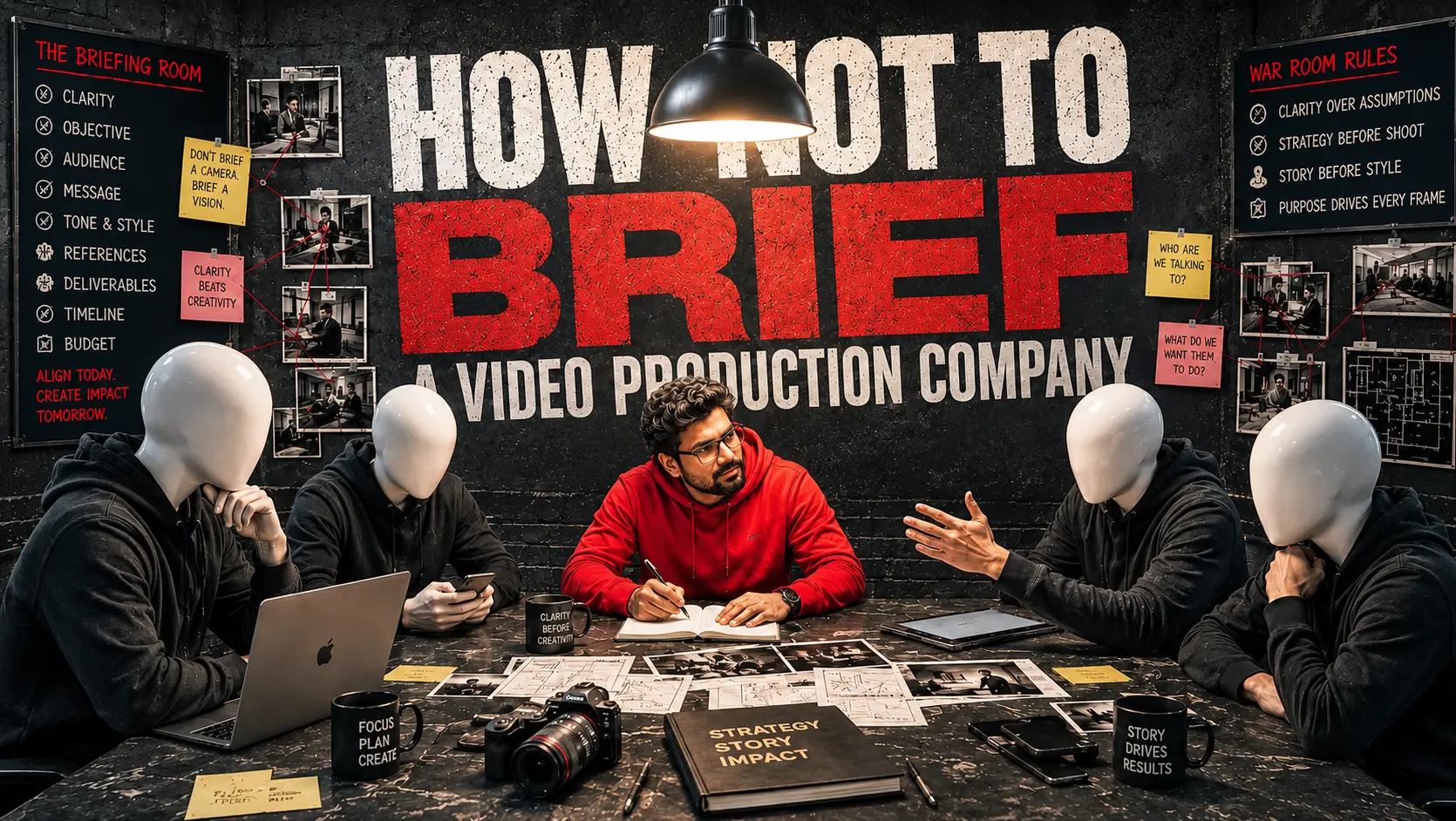
Video projects do not fail because of bad cameras. They do not fail because of editing mistakes. They fail in the briefing room weeks before a single frame is shot.
Businesses spend weeks discussing concepts only to discover that stakeholders had completely different expectations from the start. A strong brief creates clarity. A weak brief creates confusion and confusion is expensive.
“Clients come to me as a vendor. They stay with me as a partner. The difference is how much I invest in understanding their business before I pick up a camera.”
“Every client I have worked with has made at least one of these seven mistakes. I have seen all of them asked for viral videos, hidden budgets, sent references with no context, excluded decision makers. What I have learned is that these are not client failures. They are briefing failures. And briefing failures are always fixable if you catch them early enough.”
What Is a Video Production Brief?
A video production brief is a document that outlines the goals, audience, timeline, budget, messaging, and creative expectations of a video project. It serves as a roadmap for both the client and the production company ensuring everyone is working toward the same objective before production begins.
The clearer the brief, the smoother the production. The vaguer the brief, the more expensive the revisions.
7 Mistakes That Cost Hyderabad Brands Time and Money
This is the most common request in the industry. And the most misguided one.
“Viral” is not a business objective. It is a lottery ticket. A production company can build a strategy around a business goal. It cannot build a strategy around a buzzword.
Instead of “viral” ask: Do you want leads? Brand awareness? Property enquiries? Investor confidence? Product sales? The answer to that question becomes the foundation of the entire film.
A video built for everyone connects with no one. Effective videos are built for specific audiences – real estate investors, college students and parents, corporate decision makers, distributors, employees.
The more specific the audience, the more relevant the video. The more relevant the video, the more it converts.
Most clients send three YouTube links and say “we want something like this.” But what exactly do you like the cinematography? The storytelling? The editing pace? The colour grading? The background score?
References are useful only when accompanied by context. “We like the mood of this video but not the pace” is actionable. “We want something like this” is not.
Many brands hesitate to share their budget early. This almost always leads to mismatched proposals and wasted time on both sides.
A Rs.1 lakh project and a Rs.10 lakh project require completely different production approaches crew size, equipment, locations, and creative strategy. Budget transparency allows us to recommend the right solution for your constraints not the most expensive one.
This is the single biggest cause of endless revision loops. The marketing manager approves the concept. Then the founder reviews the first cut. Then another department joins in. Then additional changes appear. The project gets stuck.
Identify every person who has approval authority before production begins – not after the first edit is delivered.
Many briefs start with “we need a 2-minute corporate film.” That is a deliverable not an objective.
A better question is: what should viewers think, feel, or do after watching? The outcome matters more than the duration. The deliverable is the vehicle. The business result is the destination.
A production company does more than operate cameras. It contributes ideas, creative solutions, production planning, and storytelling expertise. The best projects happen when both sides collaborate openly not when the client sends a spec sheet and waits for delivery.
The 6 Questions Every Video Brief Must Answer
Before you call any production company in Hyderabad, Whether you need an ad film, a corporate film, a real estate brand film, a brand documentary, or drone cinematography these six questions apply to every format.have clear answers to these six questions. A production house that does not ask you all of them before quoting is going to deliver footage – not a film.
- Who is the primary audience – be specific, not “everyone”
- What is the one goal of this video – not three goals, one
- Where will the video be shown – presentation, Instagram, YouTube, WhatsApp
- What is the realistic budget – share it honestly upfront
- What does success look like – inquiries, views, investor confidence, sales
- What is the actual deadline and why – the reason matters as much as the date
A Simple Video Brief Template You Can Use Today
Copy this format and fill it in before your first meeting with any production company.
Video Production Brief Template
A Real Brief That Worked: Pavani Royale, Hyderabad
When Pavani Royale came to us for their real estate brand film, the brief was clear from day one. The audience was investors not end users. The goal was confidence not awareness. The platform was investor presentations not Instagram.
That clarity allowed us to build a 360-degree film covering location benefits, nearby landmarks, investor perspective, and company profile all structured around what an investor needs to feel before committing capital. The brief told us exactly what to make. The film did exactly what it needed to do. The client cracked their best deals using it in presentations.
That outcome did not come from a bigger budget or better equipment. It came from a better brief.
Related read: Real Estate Video Production in Hyderabad: What It Costs and What Actually Works (2026)
Related read: AI Tools vs Professional Video Production – which one is right for your project?
Related read: What is AI-Assisted Video Production? How the hybrid model works for Indian brands.
Frequently Asked Questions
How do I brief a video production company?
Start with your business objective, audience, budget, timeline, and expected deliverables. The more context you provide upfront, the better the concept you will receive in return. Use the brief template above as a starting point.
What should be included in a video production brief?
A video production brief should include business objective, target audience, key message, budget range, timeline, deliverables, creative references with context, and the names of everyone with approval authority.
How long should a video brief be?
Most effective briefs are one to three pages. Clarity matters more than length. A one-page brief that answers all eight elements is better than a ten-page document that is vague on audience and objective.
Why do video projects fail?
Most video projects fail because expectations are not aligned during the briefing stage. Vague objectives, unclear audiences, hidden budgets, and missing decision-makers are the four most common causes all of which are preventable with a thorough brief.
Should I share my budget with the production company upfront?
Yes always. Sharing your budget allows the production company to recommend the right creative solution for your constraints. Hiding your budget leads to mismatched proposals and wasted time. Any professional studio will work within your budget honestly.
What is the difference between a brief and a scope of work?
A brief is what you want. A scope of work is what gets built by whom, by when, and for how much. At Auro Media House every project begins with a detailed scope of work document that captures deliverables, shoot days, revision rounds, and payment milestones. Learn more about how we work here.
Ready to brief your next video project?
Share your brief with us and we will come back with a concept and budget within 48 hours.
Start the Conversation